
What is One Church One Day?
A Biblical Strategy for Prayer, Unity, and City Transformation
Across the world, pastors and Christian leaders sincerely pray for their communities. Churches hold prayer meetings, organize special events, serve families, preach the gospel, and work faithfully to advance God’s Kingdom.
Yet an important question remains:
Why do many communities have considerable prayer activity but experience so little measurable transformation?
The problem is not necessarily a lack of prayer. In many places, the problem is the absence of a shared prayer strategy capable of connecting congregations, leaders, and believers across an entire city or region.
Individual churches pray, but they often pray in isolation. Leaders may share similar concerns, but they rarely possess a practical structure through which they can assess their community, establish priorities, coordinate prayer, build trusted relationships, and act together.
One Church One Day was developed to address that challenge.
What Is One Church One Day?
One Church One Day is a practical biblical strategy that helps the many diverse congregations in a community function more effectively as one Church.
The strategy equips leaders to:
Establish continual prayer across a city or region
Strengthen relationships among pastors and Christian leaders
Identify and mobilize catalytic servant leaders
Connect prayer with informed and coordinated action
Engage leaders from the major spheres of society
Assess the spiritual and practical condition of a community
Develop sustainable strategies for measurable transformation
The name expresses a simple organizing principle: each participating congregation adopts one day of prayer every month. As more churches participate, a city or region can establish a continual canopy of prayer.
One church takes the first day. Another takes the second. Others take additional days until the entire month is covered.
However, One Church One Day is much more than filling dates on a prayer calendar. The calendar provides an entry point into a larger process of relationship, assessment, strategic prayer, leadership development, communication, and coordinated Kingdom service. It helps move the Church from occasional events to sustainable spiritual infrastructure.
Many Congregations—One Church
The New Testament frequently speaks of the Church in a city as one Church, even though believers met in many locations. There were many congregations, households, leaders, gifts, and expressions, but Scripture recognized one Church in Jerusalem, one Church in Antioch, one Church in Ephesus, and one Church in each city. One Church One Day does not require congregations to surrender their identity, doctrine, leadership, property, or distinct assignment. It honors the beautiful diversity within the body of Christ.
The strategy simply recognizes that no single congregation possesses every gift, relationship, resource, or calling necessary to serve an entire community.
We need one another. When churches develop trusted relationships and work together, their combined witness becomes stronger. Prayer becomes more informed. Resources are stewarded more wisely. Gaps in ministry become easier to recognize. Leaders gain encouragement, and the Church becomes better equipped to address the spiritual and practical challenges facing its community.
Jesus prayed that His followers would become one so the world would believe the Father had sent Him. Biblical unity is therefore not merely a pleasant ideal. It is connected to the credibility and effectiveness of our witness.
From Prayer Activity to a Prayer Strategy
Prayer is foundational, but strategy helps prayer become focused, informed, and sustainable. Nehemiah prayed, assessed the condition of Jerusalem, consulted with leaders, organized families, assigned responsibilities, rebuilt the wall, established watchmen, and addressed the conditions that threatened the community.
Prayer and action worked together.
King David also combined spiritual revelation with strategic organization. He brought the ark of God’s presence into the center of the city, established worship and prayer, organized leaders, assigned responsibilities, and prepared the way for future generations.
Acts 15:16 and Amos 9:11 connect the restoration of David’s fallen tabernacle with the harvest of nations.
One Church One Day applies these enduring biblical principles in a modern context. It helps leaders establish prayer while building the relationships, communication, leadership, and strategic processes required to serve a city or region effectively.
A prayer strategy asks:
What is God saying about our community?
What is the spiritual condition of the Church?
Where are churches already praying and serving?
Where are the gaps?
Which challenges require a coordinated response?
Who are the trusted leaders God has already prepared?
What gifts and resources are present in the body of Christ?
What measurable conditions should we prayerfully address?
What responsibilities should be assigned?
How will we evaluate progress and give God glory for the results?
These questions help leaders move from good intentions into wise, coordinated action.
Prayer Begins at Home
The foundation of continual prayer is not an organization or a citywide meeting. It begins with individuals and households.
The Prayer Wall Strategy helps heads of households and family members establish prayer in their homes. Those households form a stronger foundation for prayer within their congregations. Participating congregations then connect their adopted days of prayer across the community.
The pattern expands:
Individuals → Families → Congregations → Cities and Regions
This creates a prayer wall made of living stones—believers who faithfully stand in the gap for their families, churches, communities, and nations.
Citywide prayer will not remain strong if prayer is absent from our homes. Strong movements are built upon strong foundations.
Engaging the Whole Community
The Church’s assignment extends beyond what happens inside church buildings.
Cities are influenced through several major spheres, including:
Church and ministry
Government
Business
Education
Healthcare
Media
Family
God has placed believers and Kingdom-minded leaders throughout these areas. One Church One Day helps recognize, connect, and mobilize them. Pastors and fivefold ministers provide essential spiritual leadership, but they are not called to perform every community assignment themselves. Business leaders understand economic challenges. Educators understand schools and students. Healthcare leaders understand community health. Government leaders understand civic systems. Parents understand the pressures facing families.
When these leaders pray, communicate, and work together with humility and biblical wisdom, the Church becomes better equipped to serve its community.
Moving From Vision to Measurable Transformation
Transformation is more than holding a successful event. It involves sustained change that can be observed over time. Communities using principles associated with One Church One Day have reported outcomes such as:
Greater cooperation among churches
Continual prayer established across cities and regions
Stronger relationships between church and civic leaders
New houses of prayer and congregations
Reduced crime
Lower unemployment
Improved educational outcomes
Increased adoptions
Stronger local economies
Evangelistic growth
Supernatural answers to prayer
Not every community will experience the same results in the same way or at the same pace. God remains sovereign, and transformation cannot be manufactured through human effort. However, leaders can faithfully pray, assess, prepare, organize, act, measure, learn, and adjust. We can prepare the way of the Lord.
Where Should Your Church or City Begin?
You do not need to wait until every church agrees or every condition is perfect.
Catalytic leaders begin by praying, listening, assessing, building relationships, and taking the next faithful step.
King David consulted with the leaders and took action to bring the ark of God’s presence into the center of the city of David, the capital of Israel, and into a tabernacle. In the same way, leaders today can pray, consult, decide, prepare, and act to invite God’s abiding presence into their communities.
The first step is understanding your current condition.
Does your community have prayer meetings—or a sustainable prayer strategy?
Are churches connected relationally, or do they primarily work in isolation?
Have leaders assessed the spiritual and practical condition of the community?
Are catalytic leaders from the Church and the major spheres of society working together?
Is there a process for translating prayer and vision into coordinated action?
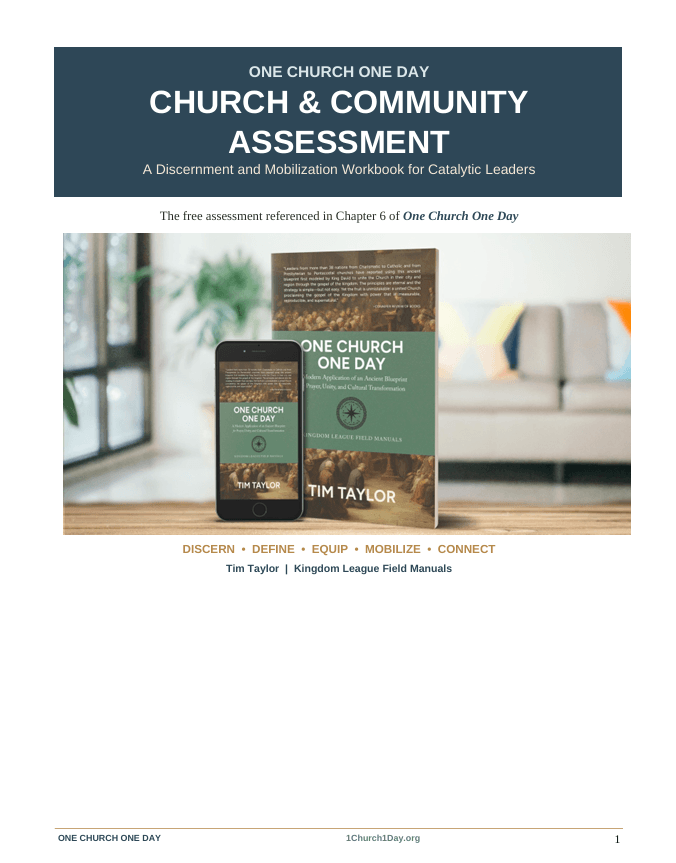
The free One Church One Day Church & Community Transformation Assessment is designed to help you answer these questions and identify your next strategic step.
Take the Next Step
Whether your community is just beginning to explore church unity or already has an established prayer movement, the assessment will help you recognize strengths, identify gaps, and consider practical next steps.
Take the free One Church One Day Church & Community Transformation Assessment.
Discover where your church or city stands—and what the next faithful step may be.
One Church in every city. Every county. Every region. Every nation.
For King Jesus.
SHARE


